


01 May Carlos Cartama
Residency Programme: May 2016
Phoenix dactylifera
At number 15 on Federico García Lorca Street in that town stood a 20-meter-tall palm tree estimated to be between 150 and 200 years old, according to collected testimonies.
Although in good health and highly appreciated for the quality of its fruit, due to the neighbors’ constant complaints about the noise produced by its swaying on windy days and its proximity to their homes, the drastic decision was ultimately made to cut it into four parts.
The owner was contacted and permission was requested to collect and make use of the remains of the tree. Once granted, the pieces were loaded onto a truck with a crane and transported an hour away to be exhibited as part of the Cartagena Urban Art Festival program.
Once the festival ends, the four parts will be cut again into smaller pieces, perhaps to be reused as domestic furniture or eventually taken to the corresponding landfill.
The miraculous natural architecture of date palms is slowly disappearing from the Mediterranean horizon.
This subject, like no other, cannot escape the fate imposed by a society in which what is non-productive has its days numbered.
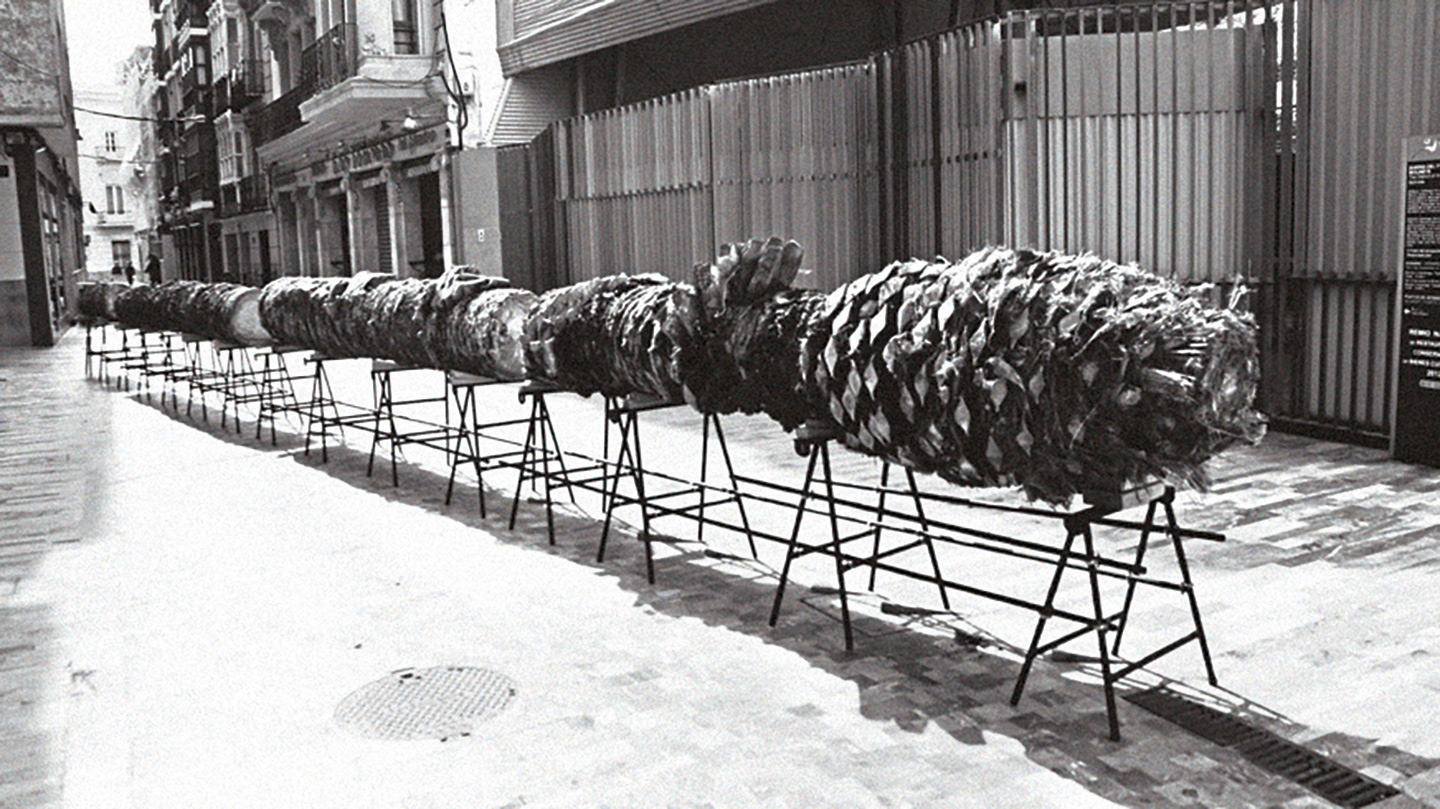
This being, which has inhabited the valley throughout the entire 20th century and the beginning of the 21st, is presented by Cartama just before being turned into raw material, placing us in a space where we no longer know whether we are standing before a subject or an object.
In a city filled with archaeological sites and riddled with heritage-protected buildings, the presence of this reclining body questions our violent relationship with the natural environment and challenges conventional criteria for heritage conservation.
(from Open Studio)
In Phoenix Dactilífera, Carlos Cartama installs the trunk of a 120-year-old palm tree cut into four sections and arranged horizontally on 20 trestles. The palm tree was collected from a plot where it had already been cut down. The lower fragment of the trunk—still standing and rooted—was pulled from the ground and transported by truck to be exhibited in Cartagena, in front of the museum-preserved ruins of the Roman Forum. After its exhibition, it was taken to the municipal landfill.
In a city filled with archaeological sites and riddled with heritage-protected buildings, the presence of this reclining body questions our violent relationship with the natural environment and challenges conventional heritage conservation criteria. At the same time, it questions the value of the artwork, which one day carries its auratic splendor and the next becomes waste material.
The miraculous natural architecture of date palms is slowly disappearing from the Mediterranean horizon due to the red palm weevil plague. These palms have also not escaped the fate imposed by a society in which the non-productive is neglected. The area is additionally suffering a severe process of desertification, while a landscape design proliferates that reflects an Orientalist ideal recreating exotic environments.
((From Mirage and Dystopia))


